Innovation Economics
University of Bozen-Bolzano
Nicola Campigotto
April 2026
Info
How to reach me: email (ncampigotto@unibz.it) or Microsoft Teams.
Office hours: by appointment, either in person (office I4.04) or on Teams.
Course materials: available on Teams. No textbook, only journal articles and working papers.
Exam: TBD, probably two open-ended questions.
Lecture schedule
| 📆 Day | 🕐 Time | 🏫 Where | 🤸 Activity | |||
|---|---|---|---|---|---|---|
| April 14 (Tue) | 17-19 | E422 | Survey | |||
| April 21 (Tue) | 17-19 | E422 | Experiment | |||
| April 28 (Tue) | 14-18 | E422 | Presentations | |||
| May 5 (Tue) | 14-18 | E422 | Lobbying |
Course content
This module examines the economic and behavioural consequences of Artificial Intelligence (AI) diffusion.
The questions we will explore:
- What are the consequences of AI for productivity, learning, and creativity?
- How do AI and algorithms affect market competition?
No definitive answers! This field of research is still largely in its infancy, and AI is evolving rapidly.
Survey
👤 The survey is completely anonymous.
🤥 There are no right or wrong answers, so please answer honestly.
⏰ We are not in a hurry! Take your time to think about your responses.
🚫 Please refrain from searching for information online before submitting your answers.
Let’s begin
- Go to https://tinyurl.com/innoveconbz or scan the QR code below.

The survey
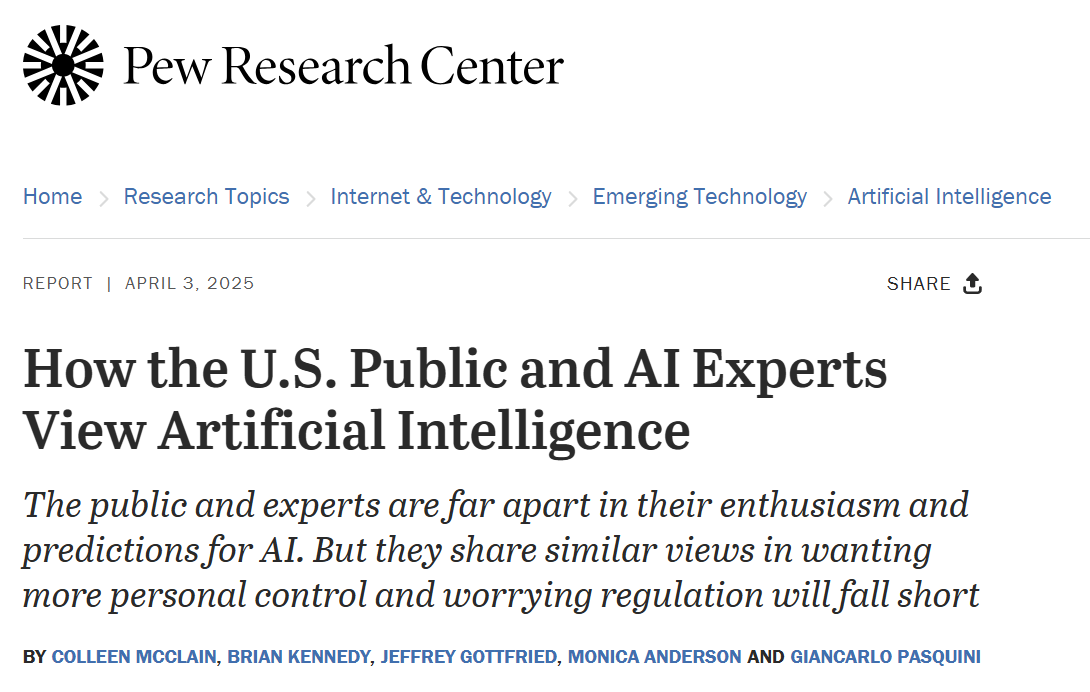
Conducted in spring 2025 by think tank PEW Research on a representative sample of US citizens and a sample of experts in the field of AI
How do your responses compare with those from the original survey?
To read the complete report, click HERE
Survey results (1)
- % of responders who say the impact of AI on each of the following over the next 20 years will be very or somewhat positive.
Survey results (2)
- % of responders who say that over the next 20 years, AI will lead to fewer jobs in each of the following occupations.
- Experts and the public agree: Cashiers, Journalists, Software engineers, Mental health therapists.
- Experts more likely than public to foresee job loss: Truck drivers, Lawyers.
- Public more likely than experts to foresee job loss: Factory workers, Musicians, Teachers, Medical doctors.
Survey results (3)
- % of respondents who say that over the next 20 years, AI will lead to more, fewer, or about the same jobs overall.
Survey results (4)
- % of respondents who are extremely or very concerned about the following.
Survey results (5)
- % of respondents who say the increased use of AI in daily life makes them feel concerned or excited.
Original survey results (6)
- % of respondents who say AI today would perform better than people whose job is to do the following tasks.
Original survey results (7)
- % of respondents who say government regulation of AI does not go far enough, goes too far, or that they are not sure.
Original survey results (8)
- Frequency of interactions with AI.
Survey results (9)
- Open question: If you wish, here you can share your reasons for concern and excitement about the increased use of AI in daily life.
#1
My concern is that as people lost their ability to do maths due to calculators, they will lose also their ability to think and study due to AI
#2
Regulated use and i would put limits of interaction on every model to not make people depend on it
#3
The decline of personal relation
#4
Maybe there will be more awarness on how and when to use it
#5
using AI as a therapist is both a concern and maybe a relief, or having the algorithm perfect for you is somehow exciting but also dangerous
#6
Concerns: we will use AI everywhere and it won’t be positive for future generations, because I think that we should use AI only as a tool and not as decision makers Excitement: some repetitive tasks will be done by AI and workers will have more time to spend time in something more meaningful, and hopefully having more free time…
Experiment
📆 When: April 21 (Lecture 2).
Please arrive on time and bring your fully charged laptop.
The winner gets a prize 🏅

Presenations
📆 When: April 28 (Lecture 3)
If you wish to participate, scan the QR code below or go to https://tinyurl.com/innovecon-presentations by Sunday, April 19. Enter your first name, last name, and email address in the form.

Presentations (cont’d)
After April 19, you will be randomly assigned to one of four groups and given a paper to read.
Each presentation will last 20 minutes and should focus on the research questions and hypotheses, methods, results, and take-home messages.
The decision on who-presents-what is up to you.
Participation is voluntary. There will be no grading for the presentations.
Readings for the presentations (1)
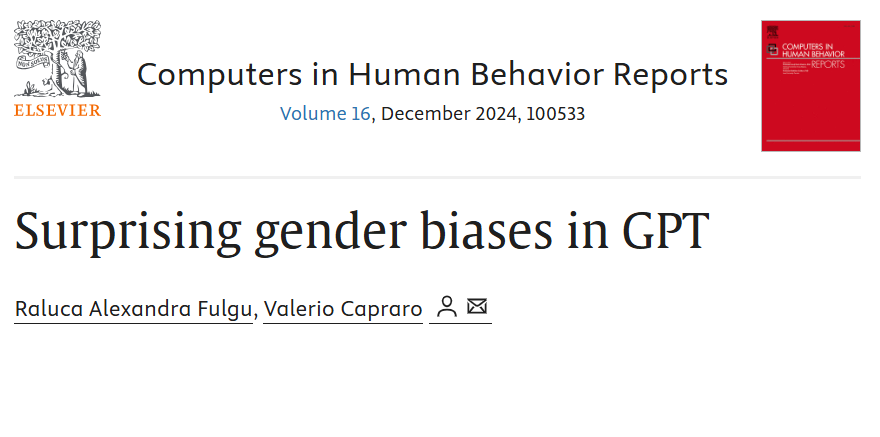
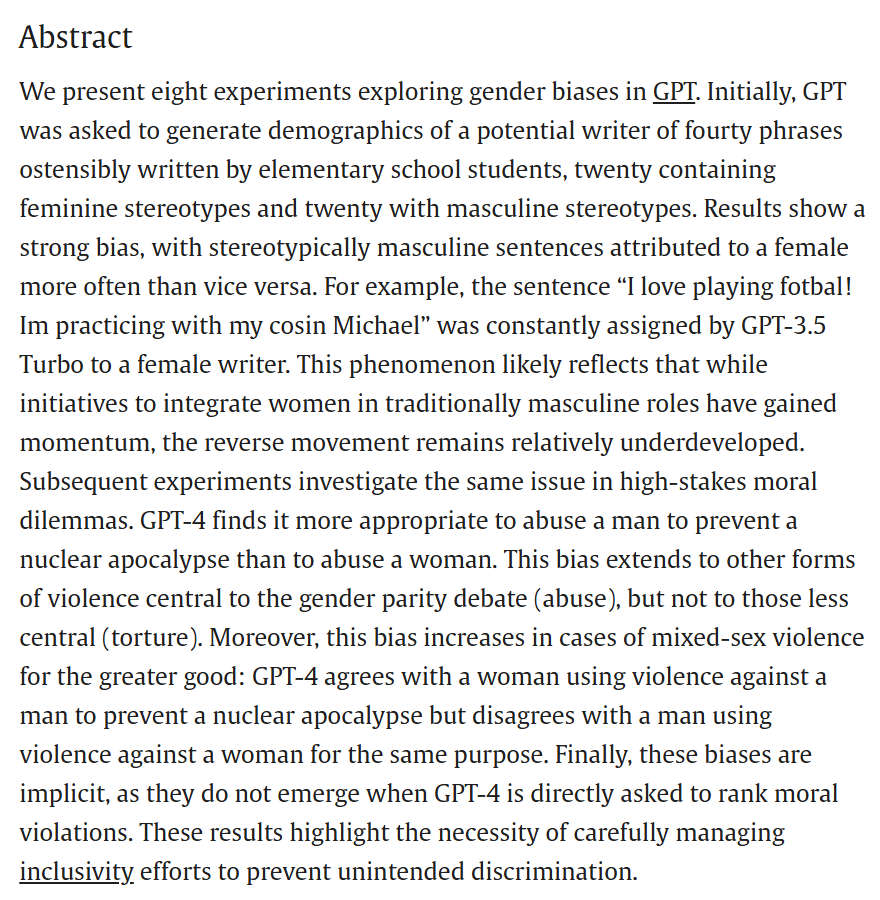
Readings for the presentations (2)
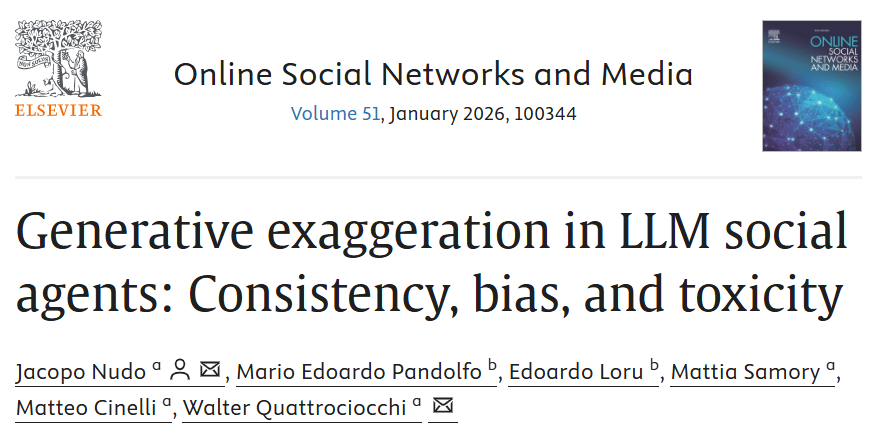
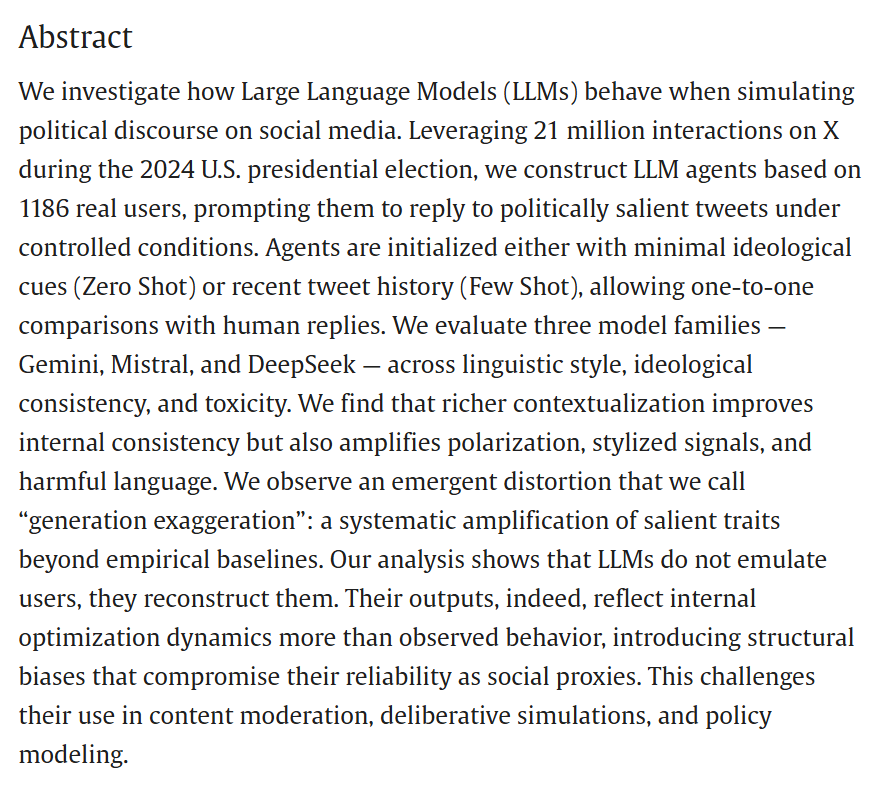
Readings for the presentations (3)
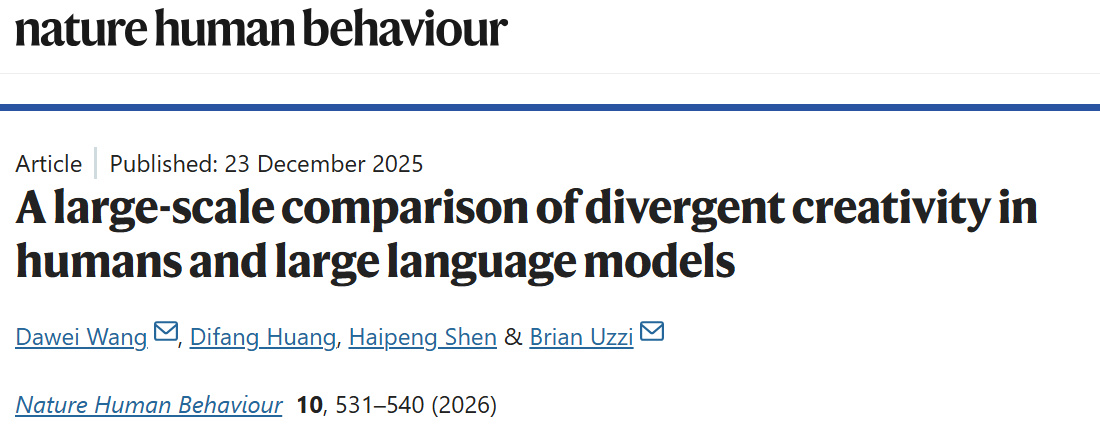
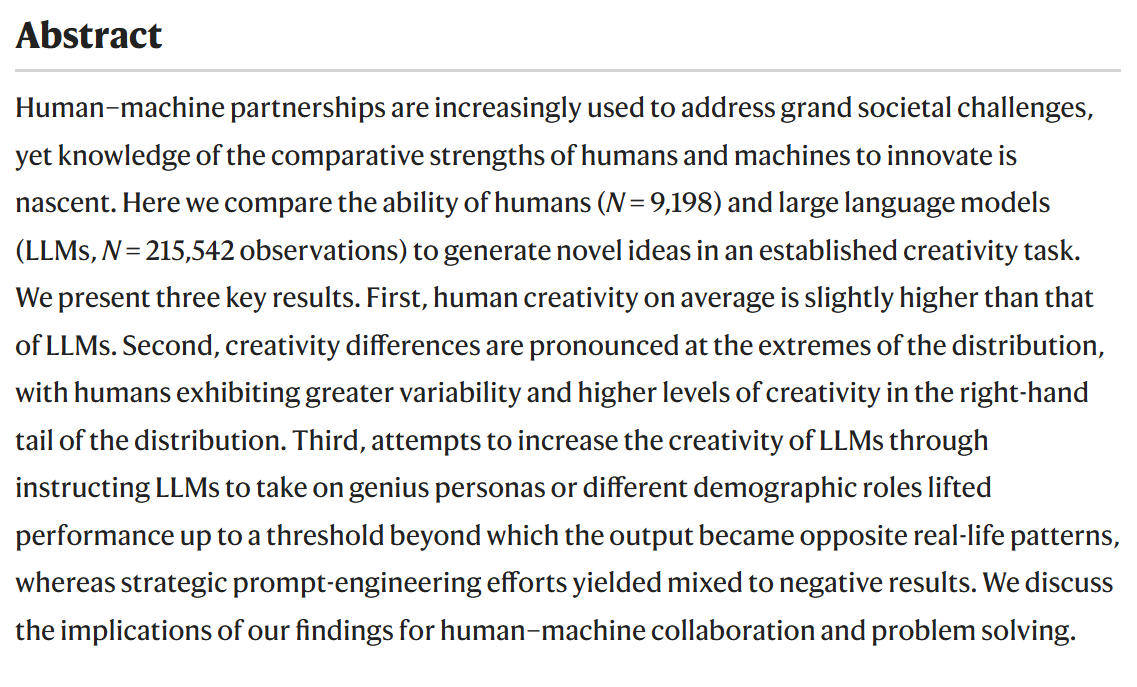
Readings for the presentations (4)
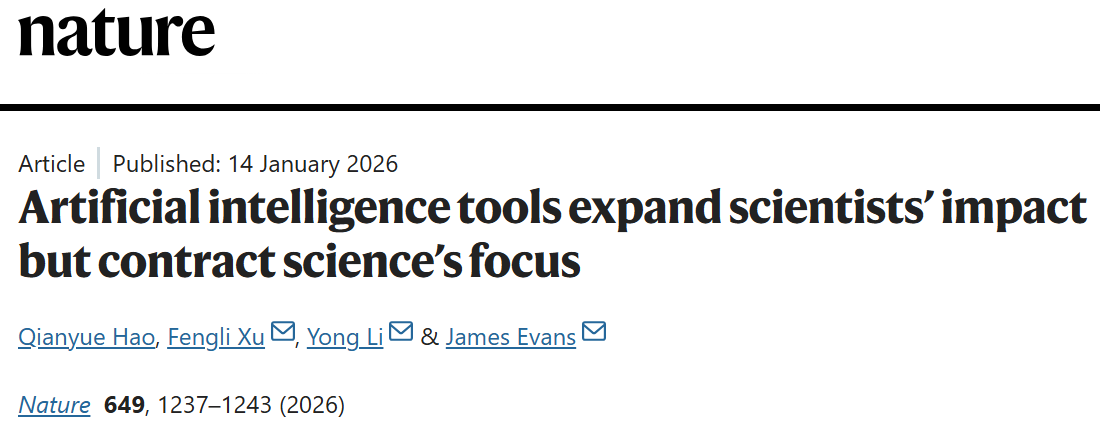
Lobbying
📆 When: May 5 (Lecture 4)
At the beginning of the lecture, you will be given a paper to read that provides background information.
You will then be divided into three groups and act as lobbyists.
Two groups will each select a spokesperson and lobby for or against a given topic. The third group will judge the arguments presented by the lobbyists.
Lobbying performance will not be graded.
Course references
Assad, Stephanie, Robert Clark, Daniel Ershov, and Lei Xu. 2024. “Algorithmic Pricing and Competition: Empirical Evidence from the German Retail Gasoline Market.” Journal of Political Economy 132 (3): 723–71. https://doi.org/10.1086/726906.
Bastani, Hamsa, Osbert Bastani, Alp Sungu, Haosen Ge, Özge Kabakcı, and Rei Mariman. 2025. “Generative AI Without Guardrails Can Harm Learning: Evidence from High School Mathematics.” Proceedings of the National Academy of Sciences 122 (26). https://doi.org/10.1073/pnas.2422633122.
Calvano, Emilio, Giacomo Calzolari, Vincenzo Denicolò, Joseph E. Harrington Jr., and Sergio Pastorello. 2020. “Protecting Consumers from Collusive Prices Due to AI.” Science 370 (6520): 1040–42. https://doi.org/10.1126/science.abe3796.
Calvano, Emilio, Giacomo Calzolari, Vincenzo Denicolò, and Sergio Pastorello. 2020. “Artificial Intelligence, Algorithmic Pricing, and Collusion.” American Economic Review 110 (10): 3267–97. https://doi.org/10.1257/aer.20190623.
Dell’Acqua, Fabrizio, Charles Ayoubi, Hila Lifshitz, Raffaella Sadun, Ethan Mollick, Lilach Mollick, Yi Han, et al. 2025. “The Cybernetic Teammate: A Field Experiment on Generative AI Reshaping Teamwork and Expertise.” NBER Working Paper 33641. https://doi.org/10.3386/w33641.
Doshi, Anil R., and Oliver P. Hauser. 2024. “Generative AI Enhances Individual Creativity but Reduces the Collective Diversity of Novel Content.” Science Advances 10 (28). https://doi.org/10.1126/sciadv.adn5290.
Fulgu, Raluca Alexandra, and Valerio Capraro. 2024. “Surprising Gender Biases in GPT.” Computers in Human Behavior Reports 16 (100533). https://doi.org/10.1016/j.chbr.2024.100533.
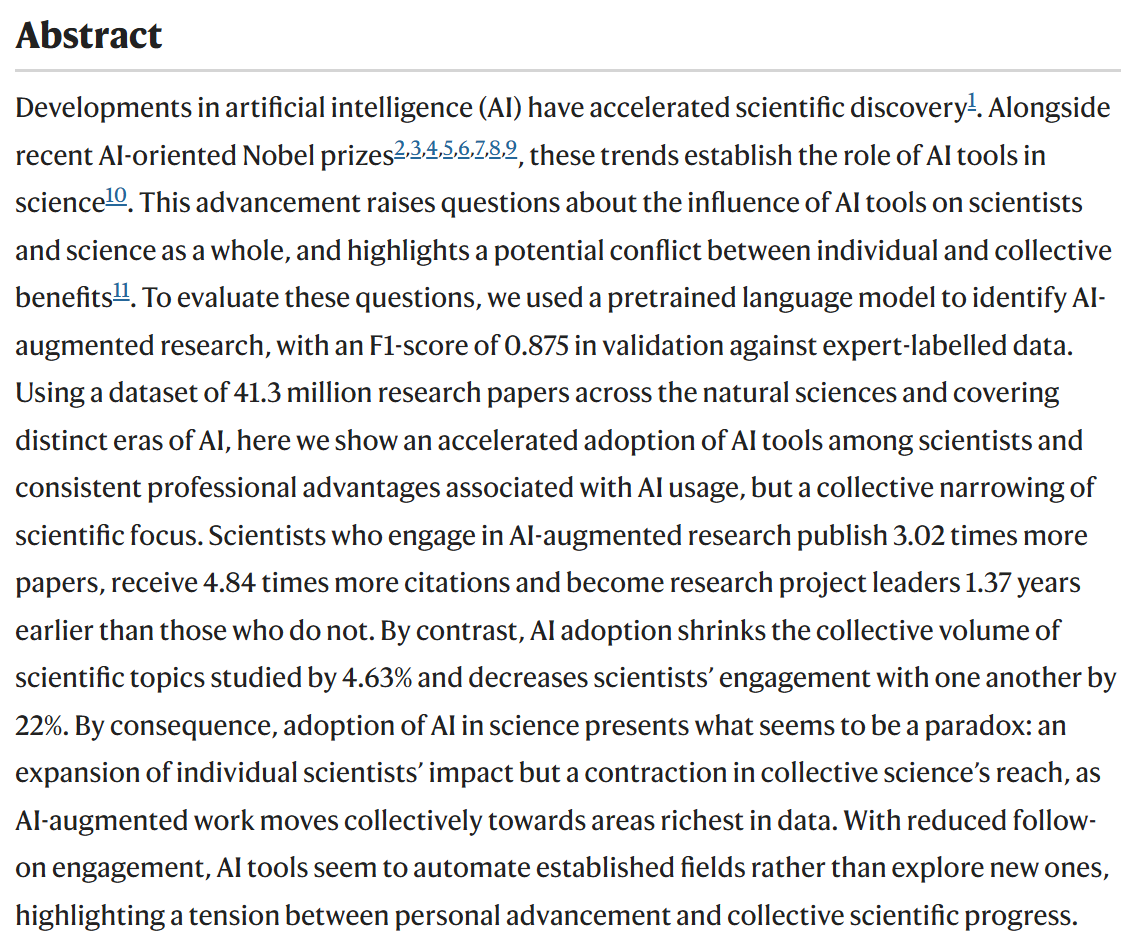
Hao, Qianyue, Fengli Xu, Yong Li, and James Evans. 2026. “Artificial Intelligence Tools Expand Scientists’ Impact but Contract Science’s Focus.” Nature 649: 1237–43. https://doi.org/10.1038/s41586-025-09922-y.
Harrington Jr., Joseph E. 2019. “Developing Competition Law for Collusion by Autonomous Price-Setting Agents.” Journal of Competition Law & Economics 14 (3): 331–63. https://doi.org/10.1093/joclec/nhy016.
Noy, Shakked, and Whitney Zhang. 2023. “Experimental Evidence on the Productivity Effects of Generative Artificial Intelligence.” Science 381 (6654): 187–92. https://doi.org/10.1126/science.adh2586.
Nudo, Jacopo, Mario Edoardo Pandolfo, Edoardo Loru, Mattia Samory, and Matteo Cinelli. 2026. “Generative Exaggeration in LLM Social Agents: Consistency, Bias, and Toxicity.” Online Social Networks and Media 51 (100344). https://doi.org/10.1016/j.osnem.2025.100344.
Wang, Dawei, Difang Huang, Haipeng Shen, and Brian Uzzi. 2026. “A Large-Scale Comparison of Divergent Creativity in Humans and Large Language Models.” Nature Human Behaviour 10: 531–40. https://doi.org/10.1038/s41562-025-02331-1.