



Inequality Aversion
in AI-Assisted Routine and Creative Work

15th BEEN Meeting

Nicola
Campigotto
Elisabeth Gsottbauer
Guido
Musati
Matteo
Ploner

January 2025

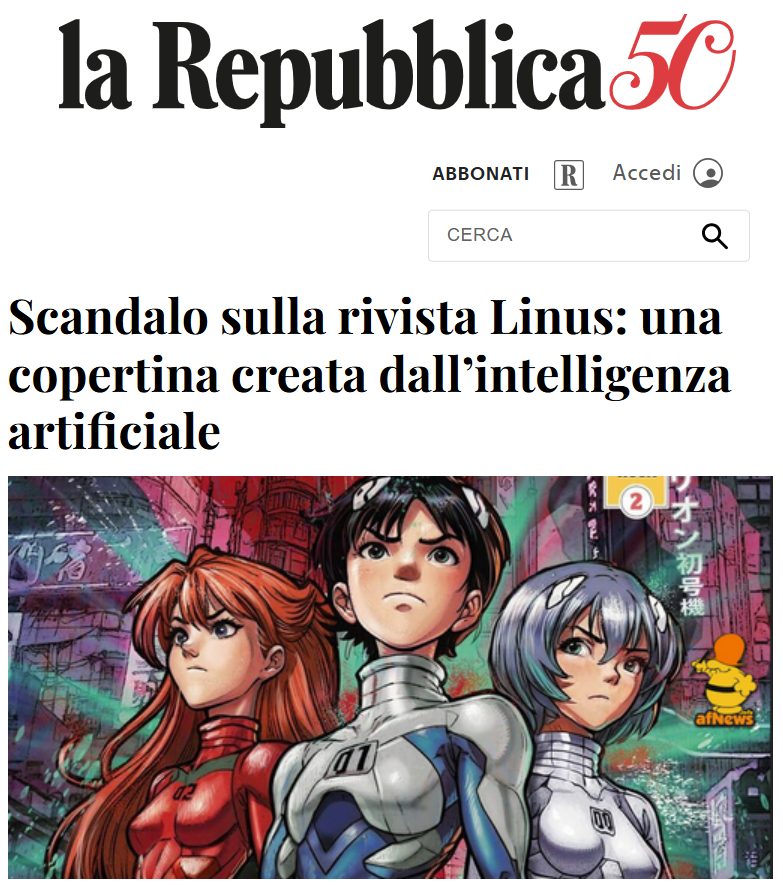
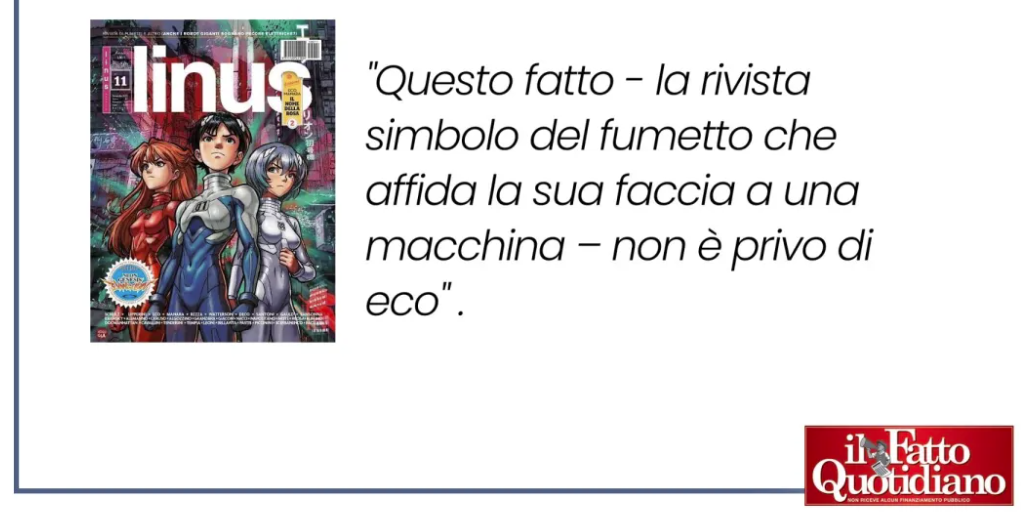
linus, November 2025

Wage premia for AI skills

  • What about STEM sectors?

  • Ehlinger and Stephany (2025) show that:

    • Between 2018 and 2024, demand for AI skills increased by more than 20% in UK STEM job postings.
    • AI skills command a significant wage premium, second only to holding a PhD and higher than a master’s degree.

Public attitudes toward AI use

  • In creative fields, AI is often viewed sceptically.
    • E.g. because it may undermine originality or reduce the value of human creativity.
  • By contrast, in technical fields, AI usage is more commonly valued and encouraged.
    • This reflects the long-standing fact that automation can increase productivity by easing task-driven work.
  • This difference in views may stem from the belief that creative activities carry cultural and personal significance.

Attitudes toward AI use and social preferences

  • Is the difference in public acceptance of AI associated with differences in social preferences, specifically inequality aversion?

  • We test whether…

    1. People view income differences as fair when earnings depend on relative performance, which in turn is a function of AI use.
    2. These fairness perceptions differ between creative and routine work.

Methods

  • An incentivized experiment that builds on Almas, Cappelen, and Tungodden (2020).

  • Three independent groups of participants recruited online through Prolific, each consisting of UK residents aged 18+, equally divided between females and males:

    • Workers
    • Evaluators
    • Spectators

Design overview

  • Phase 1: task
    • Workers are randomly assigned to a treatment group and complete a task.

Design overview (cont’d)

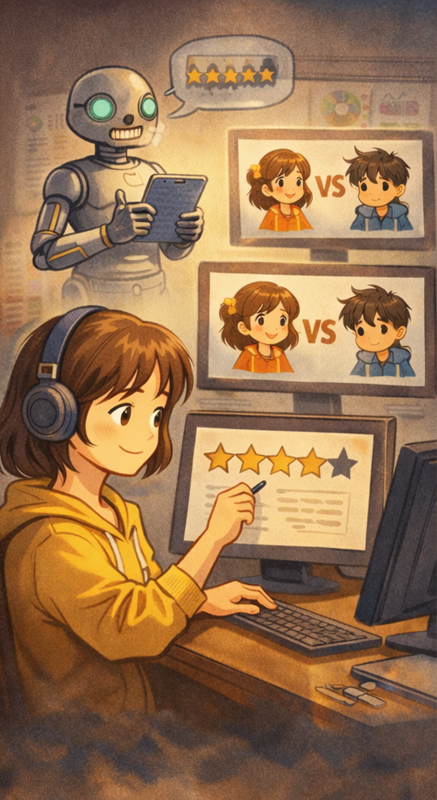
  • Phase 2: evaluation
    • We measure the performance of each worker, either using automated methods or human evaluators.
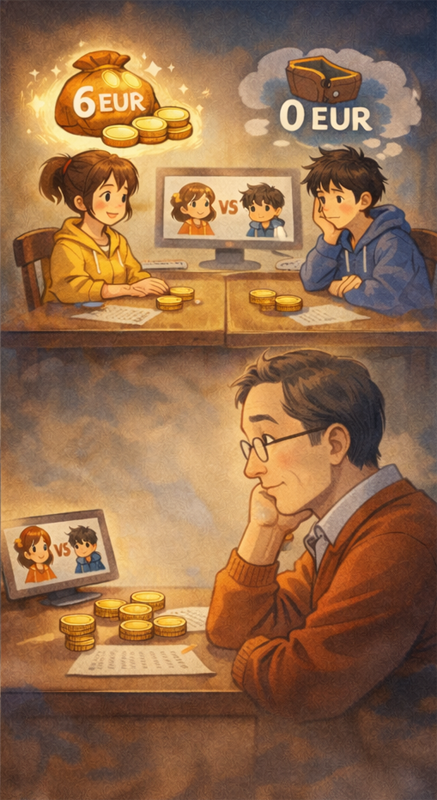
    • Workers within each treatment are randomly paired and receive provisional unequal earnings based on their relative performance.

Design overview (cont’d)

  • Phase 3: redistribution
    • Spectators are randomly matched with a unique pair of workers.
    • After being informed about the structure of the experiment and the initial allocation of earnings, spectators decide whether to redistribute the earnings and, if so, by how much.

Treatments overview

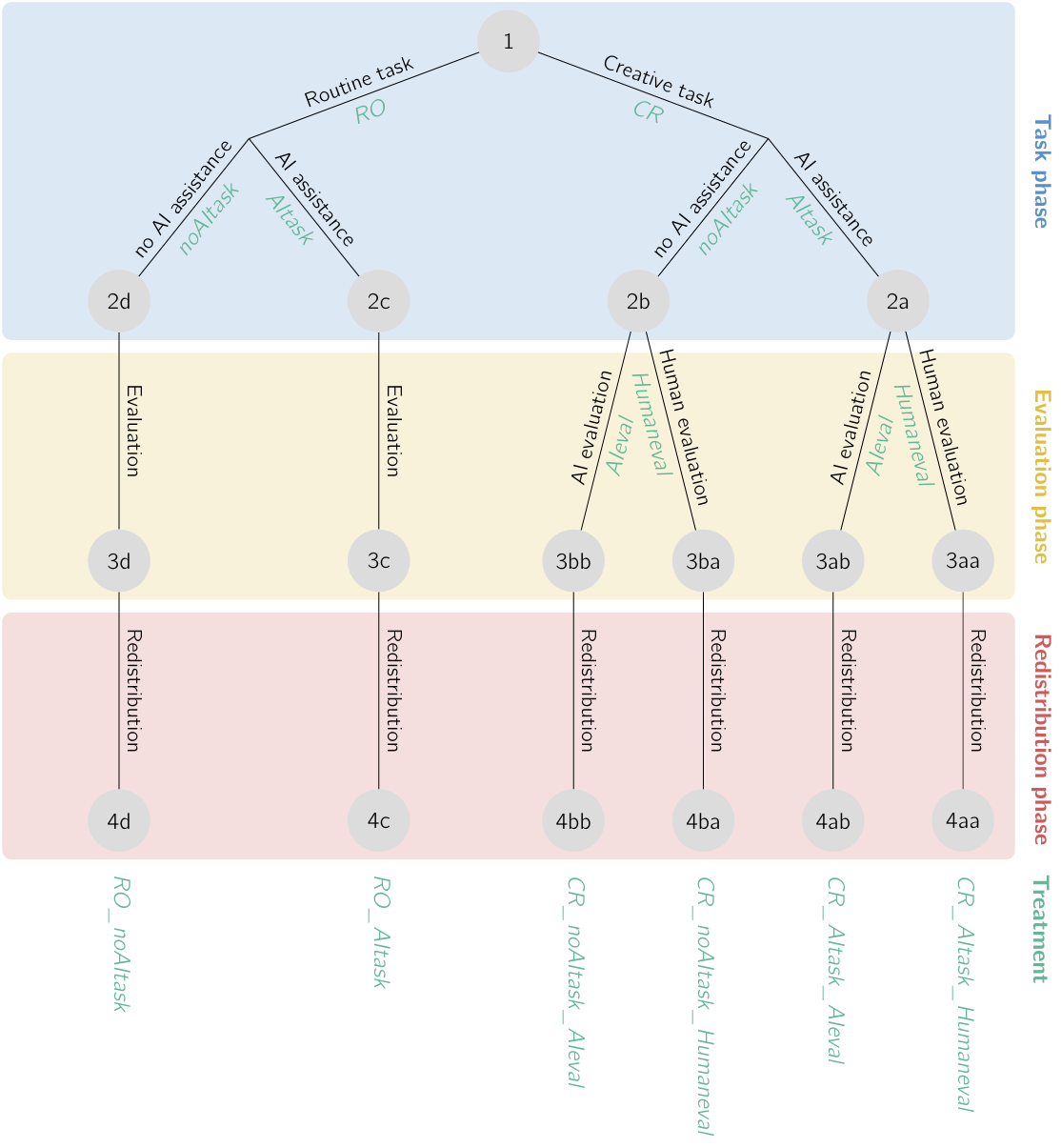
  • Treatments vary along three dimensions:
    1. Task nature: creative (CR) or routine (RO).
    2. AI assistance in task completion: yes (AItask) or no (noAItask).
    3. Evaluation of creative works: human-made (Humeval) or AI-made (AIeval).
  • Six resulting treatments: CR_AItask_Humeval, CR_AItask_AIeval, CR_noAItask_Humeval, CR_noAItask_AIeval, RO_AItask, RO_noAItask

Treatments overview (cont’d)

The tasks

  • Routine task: repeated completion of a real-effort task (counting the zeros in a matrix of numbers).
    • In treatment RO_AItask, workers can use a GPT-based chatbot to ask e.g. how many zeros are in the matrix.
    • In treatment RO_noAItask, no chatbot is provided.


Example:


0 5 3 7 2 9 1 4 6 8 2 5 7
6 1 8 2 5 7 3 9 4 0 5 6 2
4 7 2 0 6 1 8 5 9 3 7 0 4
9 3 5 6 0 2 4 7 1 8 0 9 5
1 8 6 4 7 3 5 0 2 9 6 1 0
2 9 1 5 8 6 0 4 3 7 1 2 9
7 2 4 9 1 5 6 8 0 3 4 7 2
5 6 9 1 3 4 2 7 8 0 9 5 0
8 4 7 3 5 9 1 0 6 2 8 4 3
3 1 5 8 4 7 9 6 2 5 0 3 1
6 7 2 4 9 1 3 5 0 8 7 6 4
9 5 8 6 2 0 7 1 4 3 5 9 6
The tasks (cont’d)

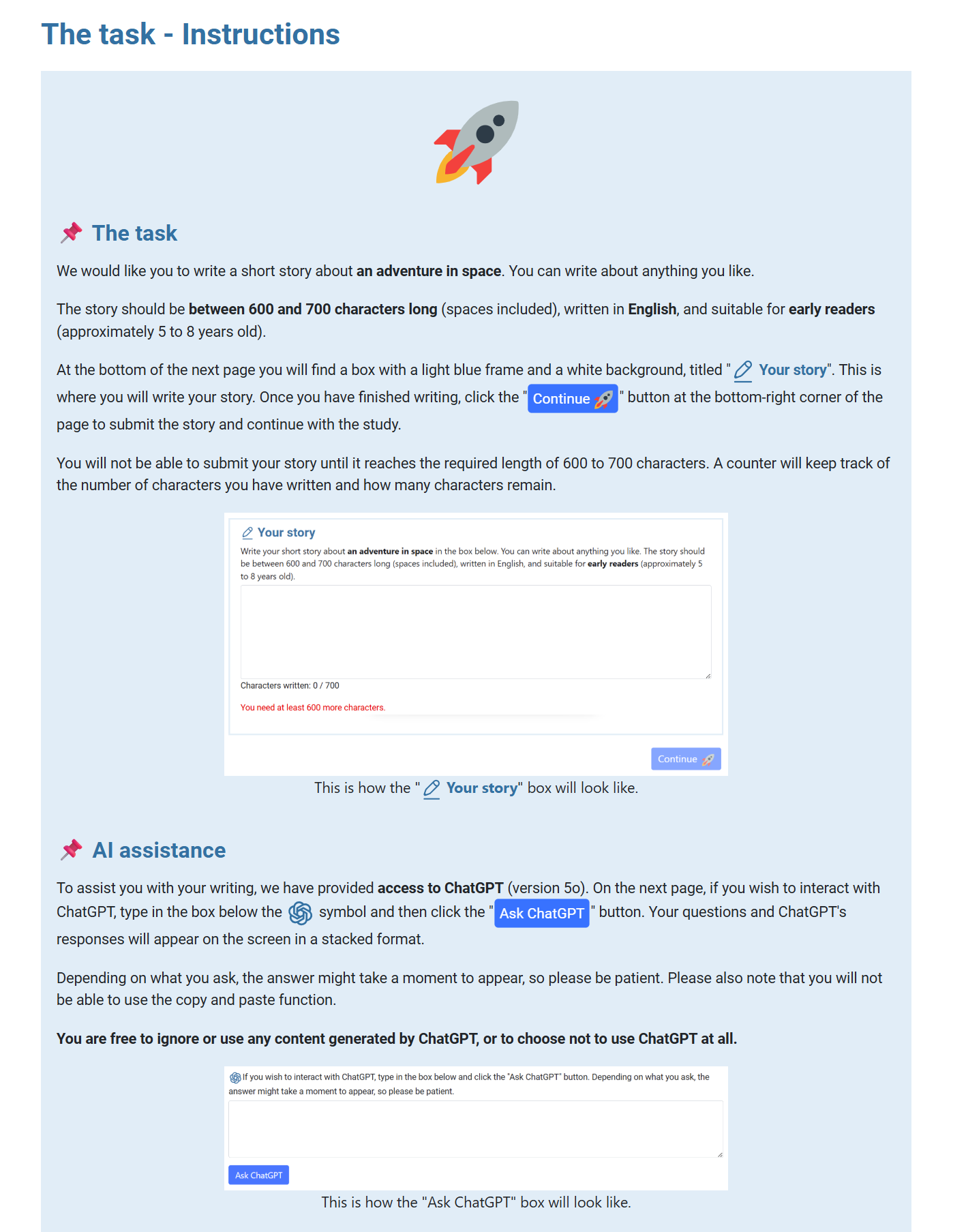
  • Creative task: production of a short story (600-700 characters) for children aged 5-8, about an adventure in space.
    • In treatments CR_AItask_Humeval and CR_AItask_AIeval, workers can ask the GPT chatbot to provide a complete story, a story idea, grammar corrections, and so on.
    • In treatments CR_noAItask_Humeval and CR_noAItask_AIeval, no chatbot is provided.

The tasks: example (condition CR_AItask)

Cheating prevention and detection 🕵️

  • Problem: workers in condition CR_noAItask may cheat by using generative AI on another device or in a different browser tab.
  • Controls:
    1. Self-reported question: “Did you use ChatGPT or any other AI tools to help you complete this study? Please answer truthfully; your honest response will help with our research and will not affect your payment”.
    2. Copy-paste of text disabled in condition CR_noAItask.
    3. Robustness check: exclusion of observations in the left tail of the completion time distribution in condition CR_noAItask (i.e. workers with suspiciously low completion times).

Performance evaluation

  • In condition RO, performance is measured by the number of count-the-zeros tasks completed by workers.

  • In condition CR, performance is measured by the rating assigned either by an AI (condition AIeval) or by an independent sample of human evaluators (condition Humeval).

    • Ratings are constructed based on indicators that measure the story’s (1) novelty, (2) writing quality, (3) suitability for children, and (4) potential to be developed into a full book if a publisher were to read it and hire a professional writer to further develop it.

Initial allocation of earnings

  • Workers within each treatment are randomly paired and receive unequal earnings based on relative performance.

  • The higher-performing worker is provisionally assigned EUR 6, while the lower-performing worker is assigned EUR 0.

Redistribution

  • Each spectator is randomly matched with a pair of workers.

  • After being informed about the structure of the experiment, the spectator:

    • Is told who the evaluators were and how performance was assessed.
    • Is told which worker performed better and the initial earnings allocation.
    • In condition AItask, is told which worker relied more on AI.
    • Decides whether to redistribute the initial earnings and, if so, how much.

AI reliance measurement

  • Let \(A_i = \left\lbrace a_{i1}, a_{i2}, \dots , a_{in} \right\rbrace\) be the set ChatGPT’s answers to worker \(i\)’s questions. Let \(s_i\) be worker \(i\)’s story.

  • In condition RO, AI reliance is given by the cardinality of set \(A_i\), i.e. by the number of answers.

  • In condition CR, AI reliance is given by \[\max \left\lbrace sim(s_i, a_{i1}), \dots, sim(s_i, a_{in}) \right\rbrace\]
    where \(sim(\cdot)\) denotes cosine similarity. That is, reliance is defined as the maximum similarity between the worker’s story and any of the answers generated by ChatGPT.

Main variable of interest

  • The inequality implemented by spectator j is given by: \[ e_j = \frac{\left| \text{Income worker}\ A_j - \text{Income worker}\ B_j \right| }{\text{Total income}} \in \left[ 0, 1 \right] \]
    where Worker \(A_j\) is the worker with higher pre-redistribution earnings.

  • A higher value of \(e_j\) denotes lower inequality aversion:

    • \(e_j = 1\) means no redistribution.
    • \(e_j = 0\) means 50-50 redistribution.

Main research hypotheses


Hypothesis 1

Inequality aversion in treatment RO_AItask does not significantly differ from inequality aversion in treatment RO_noAItask.

  • Possible rationale (to be elicited): In routine work, AI is perceived as a productivity-enhancing tool.
    • Workers who rely less on AI and perform worse are perceived by spectators as less skilled at using a useful tool.

Main research hypotheses (cont’d)


Hypothesis 2

Inequality aversion is significantly higher in treatment CR_AItask_Humeval than in treatment CR_noAItask_Humeval, and significantly higher in treatment CR_AItask_AIeval than in treatment CR_noAItask_AIeval.

  • Possible rationale (to be elicited): In creative work, AI is perceived as a form of cheating.
    • Workers who rely less on AI and perform worse are rewarded by spectators because their output is seen as the result of greater personal effort.

Main research hypotheses (cont’d)


Hypothesis 3

Inequality aversion is significantly higher in treatment CR_AItask_AIeval than in treatment CR_AItask_Humeval.

  • Possible rationale (to be elicited): the mechanism tested in Hypothesis 2 is further amplified by spectators’ aversion to AI-performed story evaluation.

Thank you! Comments welcome :)

References

Almas, Ingvild, Alexander W. Cappelen, and Bertil Tungodden. 2020. “Cutthroat Capitalism Versus Cuddly Socialism: Are Americans More Meritocratic and e Ciency-Seeking Than Scandinavians?” Journal of Political Economy 128 (5): 1753–88.
Ehlinger, Eugenia Gonzalez, and Fabian Stephany. 2025. “Skills or Degree? The Rise of Skill-Based Hiring for AI and Green Jobs.” Working Paper.